Insight
Trillion-Scale Macrocyclic Molecular Glue Space
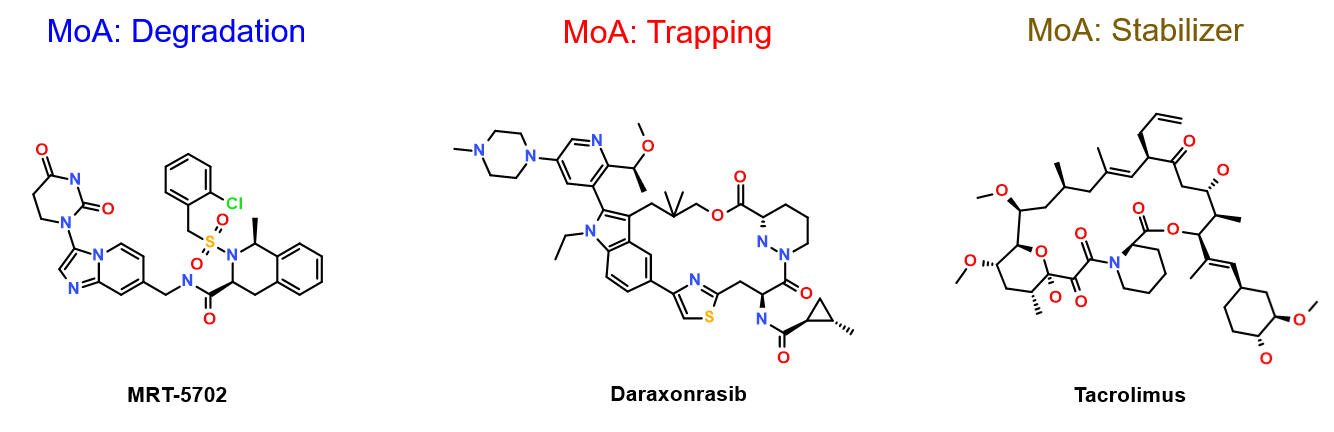
Molecular glues (MGs) function by modulating or stabilizing specific protein-protein interactions (PPIs). These small molecules can be broadly categorized by their distinct mechanisms of action:
- Targeted Protein Degraders: These MGs induce proximity between a pathogenic target protein and an E3 ubiquitin ligase, hijacking the cell’s native ubiquitin-proteasome system to facilitate ubiquitination and subsequent degradation of the disease-causing protein (e.g., MRT-5702).
- Non-degrading Molecular Glues: Certain MGs function through highly coordinated, multi-step structural changing mechanism that prevents interaction with downstream effectors (e.g., Daraxonrasib), or directly stabilize specific PPIs to alter downstream cellular signaling (e.g., Tacrolimus).
Designing Macrocyclic Molecular Glue Degraders
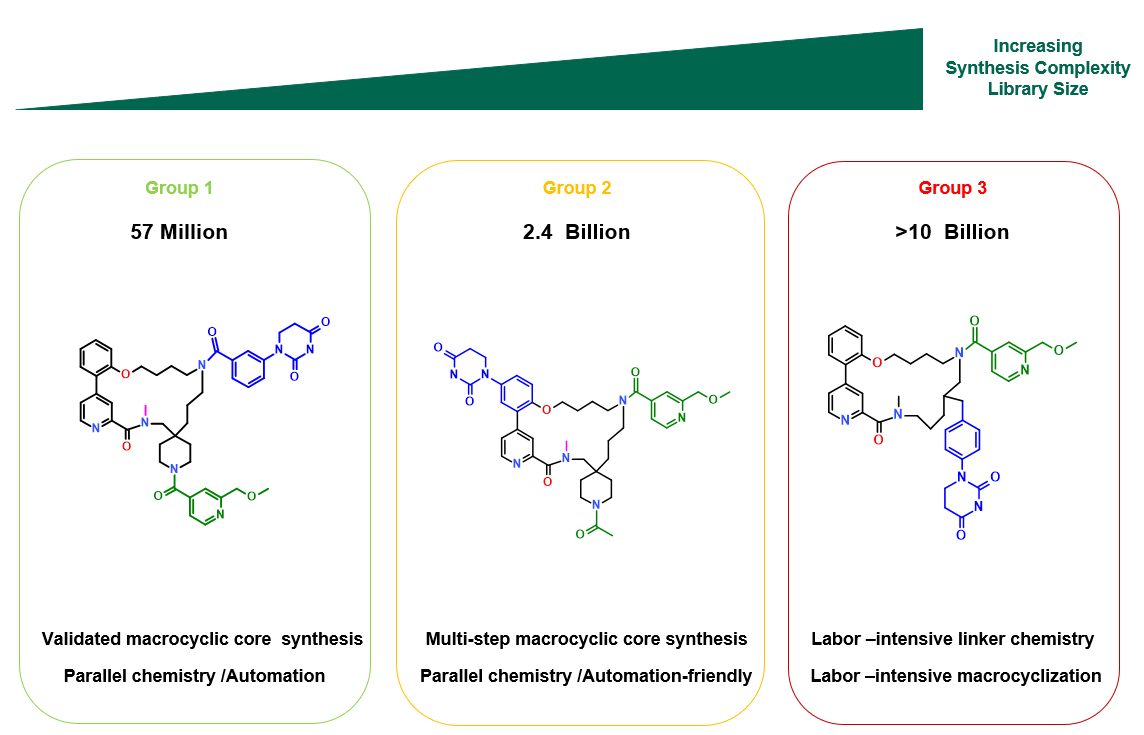
A proprietary database containing hundreds macrocyclic scaffolds was computationally evaluated to map optimal exit vectors and prospective sites of structural modification for the incorporation of E3 ligase-recruiting motifs leading to the creation of three distinct virtual sub-libraries:
- Group 1 emphasizes high synthetic accessibility, optimized for automated parallel synthesis platforms, minimized procurement lead times, and superior cost-efficiency per compound.
- Group 2 exploits the extensive combinatorial potential of bifunctional macrocyclic scaffolds to generate an expansive chemical space of synthetically plausible molecules, rendering it ideal for ultra-large-scale in silico molecular docking campaigns.
• Group 3 represents the maximum attainable structural diversity, generated via the exhaustive cross-coupling of the macrocyclic cores with an array of peripheral fragments. While offering an unparalleled chemical space, certain architectures within this library possess increased synthetic complexity and associated production costs.
Exploring macrocyclic Molecular Glue “Stabilizers” or “Trappers”
Analysis of known macrocyclic molecular glue “stabilizer” drugs revealed several macrocyclic backbone fragments that natively recognize Cyclophilin A (CypA). These fragments were taken as conservative elements to design novel macrocycles while diversifying other elements of the macrocyclic ring. Utilizing 5 most efficient macrocyclization protocols we linked the priority CypA-binding fragments with commercially available and pre-validated monomers to provide thousands diverse polyfunctional macrocyclic scaffolds. The resulting scaffolds were further developed into fully enumerated virtual library of more than 6 billion unique macrocyclic entries, suitable for in-depth in silico profiling.

For information on how to access the Macrocyclic Molecular Glue libraries or to discuss your specific project with our scientific team, please reach out to our customer support team or download the SDF