Publication
A Landmark Resource for Macrocycle Drug Discovery
Cell membrane permeability is a key property that determines whether a drug can reach its intracellular targets. It also influences if the drug can be orally bioavailable — especially for macrocycles, large ring-shaped molecules explored in drug discovery for “difficult-to-drug” targets. Yet experimental permeability data are sparse, expensive to generate, and scattered across the literature.
To address this, a new open Membrane Permeability Database for Nonpeptidic Macrocycles has been published by the researchers from Uppsala University. This curated resource compiles 5,638 discrete permeability measurements across 4,216 unique nonpeptidic macrocycles. It integrates data from 103 scientific articles and 9 patents and makes it freely available through an interactive web portal.
Our PAMPA Data: Core Contribution and Impact
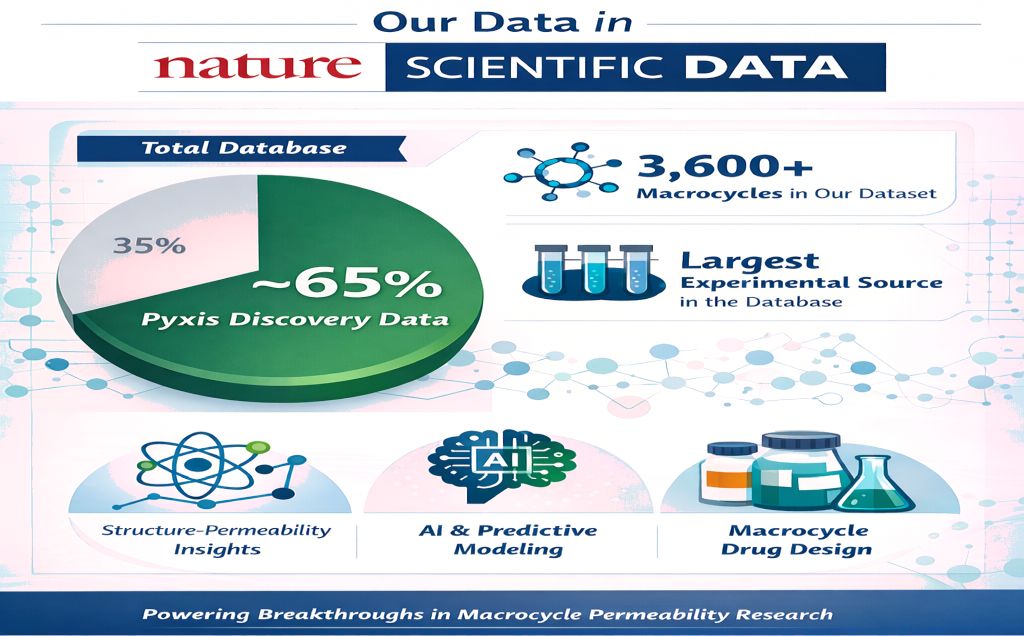
At the heart of this new database is our PAMPA data — the single largest source of consistent experimental measurements within the collection. An overwhelming majority of certain subsets of the data come from our published work. PAMPA-based passive permeability records account for 67% of the database (n = 3767). Additionally, 91% of the datapoints (n = 3462) are from our publication giving it structural and assay consistency. This anchors the entire resource.
What Makes This Database Special
Standardized and FAIR data — all permeability values have been normalized (e.g., to log scale). Moreover, structural descriptors are provided for each macrocycle, making the dataset ready for machine learning, prediction modeling, and structure–property analysis.
Broad chemical diversity — the database spans nonpeptidic and semipeptidic macrocycles. It includes tools like the newly introduced amide ratio that quantifies how peptide-like a macrocycle is. This aids classification and insight into permeability trends.
Interactive access — users can browse, filter, and download subsets of the data or the full dataset for QSAR modeling, visualization, and other analyses. They can do this directly from the web interface.
Why It Matters to Drug Discovery
This database fills a critical gap in beyond Rule of 5 chemical space by unifying large-scale experimental permeability data with standardized descriptors forming a substantial foundation, researchers now have:
- A rich training ground for predictive models of membrane permeability
- Greater insight into how structure influences permeability in macrocycles
- A platform to accelerate macrocycle drug design and optimization
For medicinal chemists and computational scientists alike, this resource — powered in significant part by our contribution — represents a significant step toward better understanding and harnessing the drug-like potential of macrocycles.